Warning Labels on Packaged Food in India: What FSSAI’s Front-of-Pack Proposal Means, and What to Check Now
A warning label on the front of chips, biscuits and drinks has been proposed in India, but it is not mandatory yet. Here is what is reported, and how to judge a pack without waiting.
4 November 2026 · 3 min read
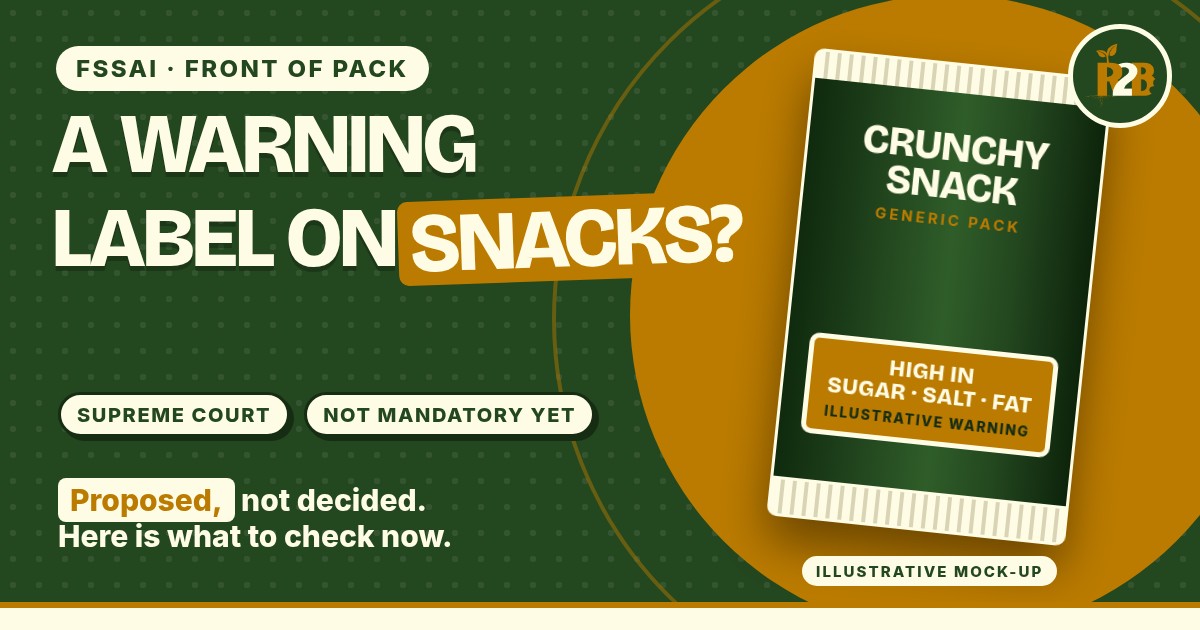
Imagine picking up a packet of chips, a biscuit or a sweetened drink and seeing a bold warning on the front: high in sugar, salt or saturated fat. In India, that is what a proposal from FSSAI, the food regulator, would do. It has been discussed in the Supreme Court this year. But it is not mandatory yet.
This guide explains what has been reported, what is still undecided, and how to judge a pack today without waiting for a new label. It is a companion to how to read a packaged food label in India.
What has been reported
- A warning label has been proposed. FSSAI has told the Supreme Court it proposes a prominent warning label on the front of packaged foods that are high in added sugar, salt and saturated fat.
- It may roll out in two steps. Reports say the first phase would apply to products that are high in two or more of these nutrients, and a later phase could cover products high in any one.
- Some foods would be exempt. Reports mention single-ingredient foods and foods that are naturally rich in fat, sugar or salt, such as ghee, edible oil, salt, sugar, jaggery and honey.
- The Supreme Court is involved. Reports say the court has been examining FSSAI’s framework and, in September 2026, asked for further clarification.
- Critics question the design. Some argue the proposed print size may not be prominent enough to be noticed.
| Question | Where things stand, as reported |
|---|---|
| Is a front-of-pack warning compulsory today? | No. It is a proposal, and details are still being worked out. |
| Which nutrients? | Added sugar, salt and saturated fat. |
| What would trigger it? | High levels of two or more of them in the first phase, according to reports. |
| Which foods are exempt? | Reportedly single-ingredient foods and naturally rich foods such as ghee, oil, salt, sugar, jaggery and honey. |
| Who decides? | FSSAI, with the Supreme Court examining the framework. |
Several of these details come from news and legal-industry write-ups rather than the final regulation, and they may change. Check the FSSAI website and the court record for the latest.
Why a front-of-pack label at all?
The nutrition table sits on the back of the pack, in small print, per 100 g or per serving. Many people never read it. A label on the front is meant to give a quick signal at the moment of choice. Whether the signal works depends on its design and on whether people trust it, which is what the debate is about.
How to judge a pack today in one minute
- Turn it over and read per 100 g, not per serving. Brands choose the serving size, and a small one makes the numbers look better.
- Look for sugar, and for added sugar if it is listed. Check the ingredient list too: sugar can appear as sucrose, glucose syrup, dextrose, maltodextrin, honey, jaggery, or fruit juice concentrate. The earlier it appears in the list, the more of it there is.
- Look at sodium, then convert it to salt. Labels list sodium. As a rule of thumb, salt is about 2.5 times the sodium figure.
- Check saturated fat. It is often listed under total fat.
- Compare two similar products side by side. The one with lower sugar, sodium and saturated fat per 100 g is the better choice on those measures.
- Ignore the front-of-pack wording for a moment. Words like “natural”, “multigrain” or “high protein” are claims, not tests. See what food claims really mean and “high protein” on Indian food labels.
- Remember “energy” just means calories. See is “energy drink” banned in India?
What a warning label would not tell you
- Whether a food is “good” or “bad”. It would flag certain nutrients, not the whole picture.
- What is right for you. People with diabetes, high blood pressure or other conditions have different needs. Ask your doctor or a registered dietitian.
- Whether the label itself is accurate. For that you need independent checks. See what a food lab report can and cannot tell you.
At Root to Bite we try to keep apart what a brand says, what has been checked, and what is still unknown. A proposed warning label is an attempt to make one important part of that, how much sugar, salt and fat is in the pack, easier to see.
This post summarises news and legal commentary on a proposal that may change. For current official rules, see the FSSAI pages below. General information only, not medical or legal advice.
Frequently asked questions
Is a front-of-pack warning label mandatory in India?
Not yet. Reports say FSSAI has proposed a prominent warning label for packaged foods high in added sugar, salt and saturated fat, and the Supreme Court has been examining the framework, but it is not compulsory today.
What would the FSSAI warning label say?
Reports describe a prominent warning, proposed in red, for products high in added sugar, salt and saturated fat. The exact design and wording are still being worked out, so check FSSAI’s website for the latest.
Which foods would be exempt from the warning label?
Reports mention single-ingredient foods and foods that are naturally rich in fat, sugar or salt, such as ghee, edible oil, salt, sugar, jaggery and honey. This may change in the final rules.
How do I check if a packaged food is high in sugar, salt or fat?
Read the nutrition table per 100 g, not per serving. Check sugar (and added sugar if listed), sodium, and saturated fat, and compare two similar products. Check the ingredient list for different names for sugar.
How do I convert sodium to salt on a label?
Salt is about 2.5 times the sodium figure. For example, 400 mg of sodium is roughly 1,000 mg, or 1 g, of salt.
Why does the nutrition table matter more than the front of the pack?
The front is marketing: words like “natural” or “high protein” are claims. The nutrition table and ingredient list are where the required facts are, and they let you compare products fairly.
Sources
- Legal 500: Front-of-pack labelling in India, Supreme Court examines FSSAI’s proposed framework
- ETV Bharat: FSSAI proposes front-of-pack warning label for food high in fat, salt and sugar
- Food Compliance International: Supreme Court and FSSAI front-of-pack warning labels
- FSSAI: Labelling and Display regulations and amendments
General information only, not medical or legal advice. The graphic is an illustrative mock-up, not an official FSSAI label. No brand sponsored or reviewed this article.