Is “Energy Drink” Banned in India? What the FSSAI Label Order and Delhi High Court Stay Really Mean
Headlines say “energy drink ban”, but the dispute is about what the can is allowed to be called. Here is what happened, what the rules say about caffeine, and how to read the label.
4 November 2026 · Updated 5 November 2026 · 4 min read
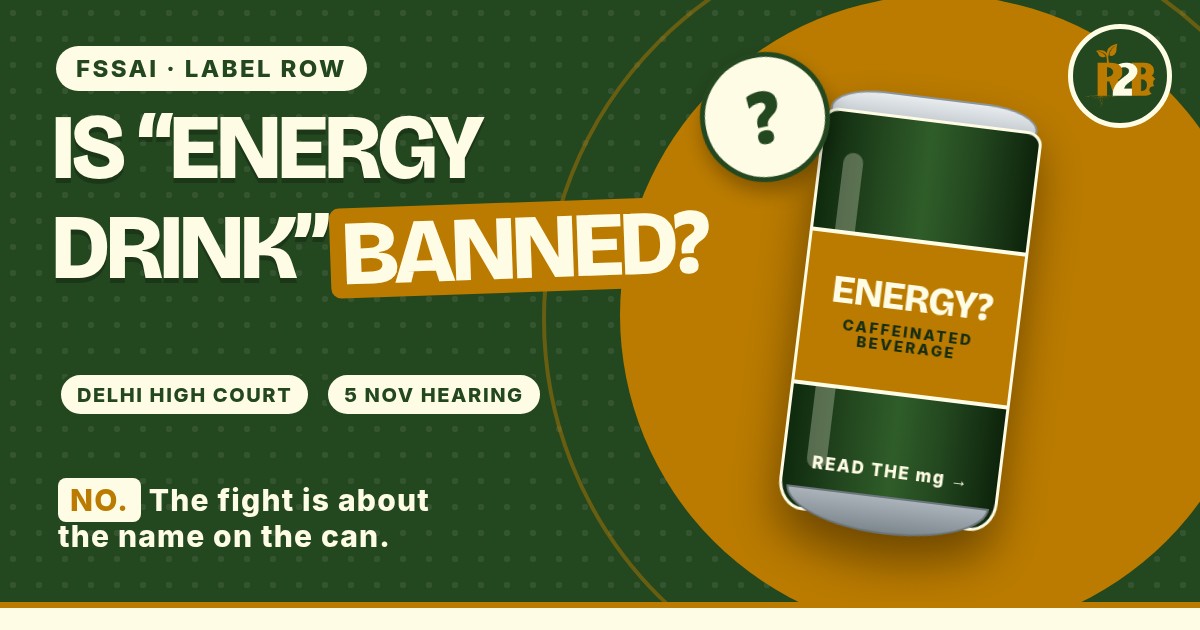
If you saw the headlines this week, you might think energy drinks are about to disappear from Indian shops. They are not. The dispute is narrower, and more interesting: it is about what the can is allowed to be called.
This guide explains what has been reported, what the Delhi High Court has done so far, what the rules say about caffeine in drinks, and how to read the can in your hand. It builds on what food claims really mean.
So, is “energy drink” banned in India?
No. Based on news reports, FSSAI issued a directive on 30 June asking makers of certain high-caffeine drinks, including PepsiCo, Monster and Reliance’s Campa, to stop using the descriptor “energy drink” on their products. That is a labelling directive. It is not an order to stop selling the drinks.
What has happened so far
- FSSAI’s position, as reported: India has no separate regulatory category called “energy drink”, and using the term can mislead consumers.
- The Delhi High Court has paused the directive for now. Reports say it stayed FSSAI’s orders for PepsiCo, Monster and Reliance, and that Red Bull had earlier received similar relief. The reasoning reported is mainly procedural: that the companies were not given a show-cause notice or a hearing before the directive was issued.
- It is an interim stay, not a final ruling. The court issued notice to FSSAI and the Health Ministry and listed the matters for further hearing on 5 November 2026.
- Stock on shelves. Reports say existing stock with the label can be sold, while no new labelled products can be made while the matter is pending.
We take no side on who is right. The court will decide, and details may change after the next hearing. What matters for you is what the label has to tell you either way.
What the caffeine rules say
Under FSSAI’s standards for caffeinated beverages, as reported, these drinks are not meant to be a free-for-all. Reports on the rules describe:
| What | What the rules are reported to say |
|---|---|
| Name on the label | Drinks with caffeine above 145 mg per litre are labelled as “caffeinated beverage”. |
| Caffeine range | Caffeine is reported to be between 145 mg and 300 mg per litre. |
| High caffeine declaration | The label should say “high caffeine” and show the amount of caffeine. |
| Daily limit | A line such as “consume not more than 500 ml per day”. |
| Warning | A prominent note that the drink is not recommended for children, pregnant or lactating women, or people sensitive to caffeine. |
FSSAI has also been reported to be reviewing these standards, so check the FSSAI website for the current wording rather than relying on any one summary.
How to read an energy or caffeinated drink label
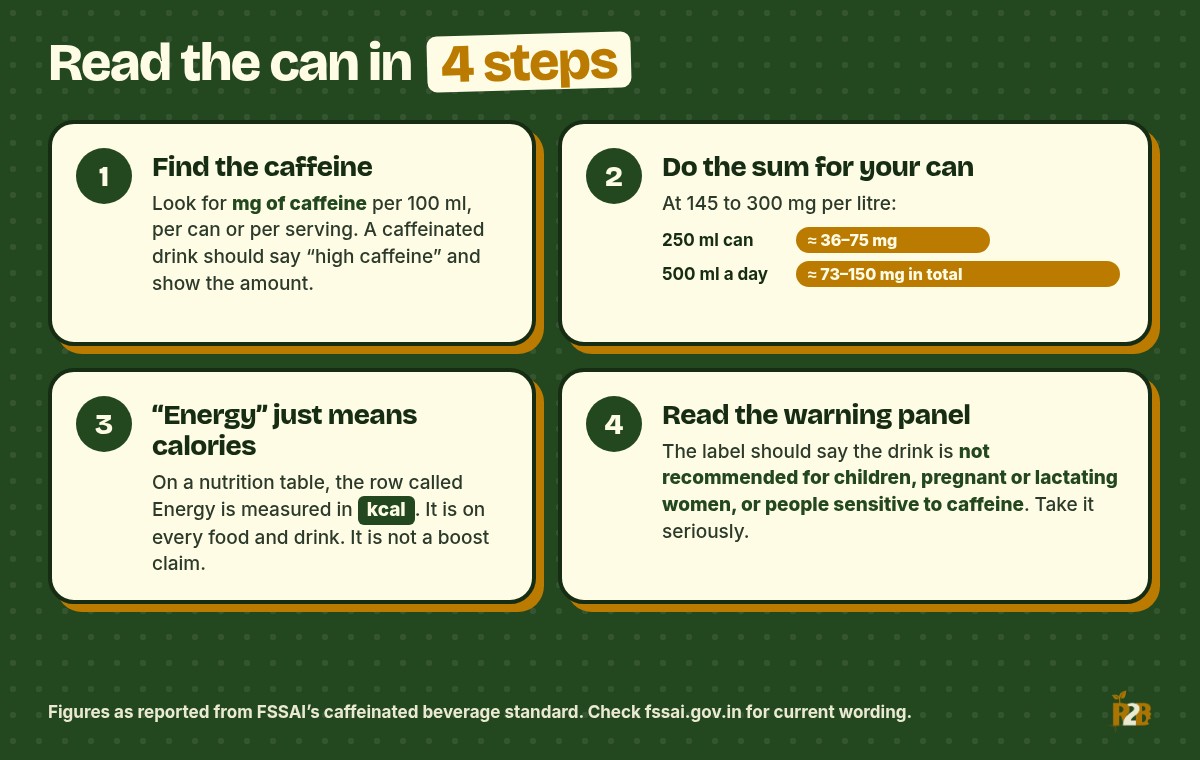
- Find the caffeine amount. Look for it per 100 ml, per can or per serving, and work out how much is in the whole can.
- Do the sum for the can size. At 145 to 300 mg per litre, a 250 ml can works out to roughly 36 to 75 mg of caffeine. At 500 ml a day, the upper limit on the label, that is roughly 73 to 150 mg in total.
- Remember that “energy” in the nutrition table just means calories. The row labelled “Energy” (kcal) is the same word on every pack. It does not mean the drink gives you a boost beyond its calories and caffeine.
- Check the sugar and any sweeteners. Many drinks in this category are high in sugar. See how to read a food label.
- Read the ingredient list. Look for caffeine, taurine, vitamins and added colours. See what the numbers in an ingredient list mean.
- Read the warning panel. If it says the drink is not recommended for children or pregnant or lactating women, take it seriously.
- Check the FSSAI number and the dates. See how to check an FSSAI licence number.
Who should be especially careful
The label’s own warning names children, pregnant or lactating women and people sensitive to caffeine. If you have a heart condition, high blood pressure, anxiety, sleep problems or take regular medication, ask your doctor about caffeine. Mixing caffeinated drinks with alcohol or hard exercise is something doctors commonly caution against. Do not use energy drinks to replace sleep.
What this row cannot tell you
- Whether any particular drink is “good” or “bad”. The dispute is about naming, not a ruling on safety.
- How the case will end. The stay is interim and the next hearing may change things.
- What is right for your body. Caffeine affects people differently.
At Root to Bite we try to separate what a brand says, what has been checked, and what is still unknown. A name on a can is a claim; the caffeine figure, the warning and the nutrition table are where the facts are.
This post summarises news reports and may change after the court’s next hearing. For current rules see the FSSAI pages below. General information only, not medical or legal advice.
Frequently asked questions
Is energy drink banned in India?
No. Reports say FSSAI directed some companies to stop using the descriptor “energy drink” on their labels, but that is a labelling directive, not a ban on selling the drinks. The Delhi High Court has stayed that directive for now, and the matter is listed for further hearing on 5 November 2026.
What did the Delhi High Court decide about energy drinks?
It has paused, on an interim basis, FSSAI’s directive for PepsiCo, Monster and Reliance, according to news reports. The reasoning reported is mainly procedural, because the companies were not given a show-cause notice or hearing first. It is not a final ruling.
How much caffeine is allowed in an energy drink in India?
FSSAI’s caffeinated beverage standard is reported to set caffeine between 145 mg and 300 mg per litre, with labelling such as “high caffeine” and a daily limit of 500 ml. FSSAI is reported to be reviewing the standard, so check the current wording on its website.
What does “caffeinated beverage” on a label mean?
It is the name FSSAI’s standards use for non-alcoholic drinks with caffeine above 145 mg per litre. These drinks should show the caffeine amount, a daily consumption limit and a warning for children, pregnant or lactating women and people sensitive to caffeine.
Does “energy” on a nutrition table mean the drink gives energy?
On a nutrition table, “energy” just means calories, in kcal, and appears on every food and drink. It is not a claim that the product boosts your energy.
Who should avoid energy drinks?
The label warning names children, pregnant or lactating women and people sensitive to caffeine. If you have a heart condition, high blood pressure, anxiety or sleep problems, or take regular medication, ask your doctor first.
Sources
- Storyboard18: Delhi HC relief puts FSSAI’s energy drink label crackdown on hold
- Exchange4media: PepsiCo, Monster and Reliance can keep the energy drink label as Delhi HC pauses FSSAI order
- LiveLaw: Delhi High Court stays FSSAI orders on the energy drink label
- FoodNavigator-Asia: FSSAI orders energy drinks to comply with regulations
- FSSAI: Food Safety and Standards Authority of India
General information only, not medical or legal advice. This article summarises news reports about an ongoing court case. No brand sponsored or reviewed it.
- 5 November 2026: Update: the case was listed for further hearing today, and we have not yet seen a report of the outcome. We will update this page. Reports also say the court set aside FSSAI’s order against Red Bull on 29 September (leaving FSSAI free to issue a fresh order after a hearing), and on 15 October declined PepsiCo urgent permission to keep making products with the descriptor while the interim stay on FSSAI’s order continued until the next hearing.