How to Read a Supplement Label in India (FSSAI): Protein Powder, Vitamins and Nutraceuticals
Protein powders, vitamins and “nutraceuticals” are regulated as food in India, not medicine. Here is what their labels should show, and five checks to make before you buy.
6 November 2026 · 3 min read
Protein powders, multivitamins, omega-3 capsules, herbal mixes: the supplement shelf keeps growing, and so do the claims on it. In India these products are regulated as food, under FSSAI, not as medicines. That has a very practical meaning for how you read the label.
This guide explains what FSSAI’s supplement rules expect on a pack, and five checks you can make in two minutes. It builds on how to read a packaged food label.
Health supplement or nutraceutical: what is the difference?
FSSAI’s 2016 regulations cover health supplements, nutraceuticals, foods for special dietary use, foods for special medical purposes, functional foods and novel foods. In everyday shopping you will mostly see two words: health supplement (for example a vitamin, mineral, amino acid or protein product) and nutraceutical (a product with a specific ingredient claimed to support a body function). Both are sold as food, and neither is a medicine.
What the label should show
Summaries of the rules, from consultancy write-ups, describe label items like these. The exact wording is in the FSSAI regulations, so use this as a checklist, not a legal text.
| Label item | What to look for |
|---|---|
| The category | The words “health supplement” or “nutraceutical”, and the product’s common name. |
| A “not for medicinal use” statement | A prominent statement that the product is not a medicine. Wording varies between summaries (for example “not for medicinal use”). |
| Amount of each active ingredient | How much of each active ingredient is in each serving, in units such as mg, mcg or g. |
| Recommended daily use | How much to take per day, with a warning not to exceed it. |
| A reminder it is not a substitute for food | A statement that the product is not meant to replace a varied diet. |
| Business details and the FSSAI number | Manufacturer or marketer, the 14-digit licence or registration number, batch and dates. |
Five checks before you buy
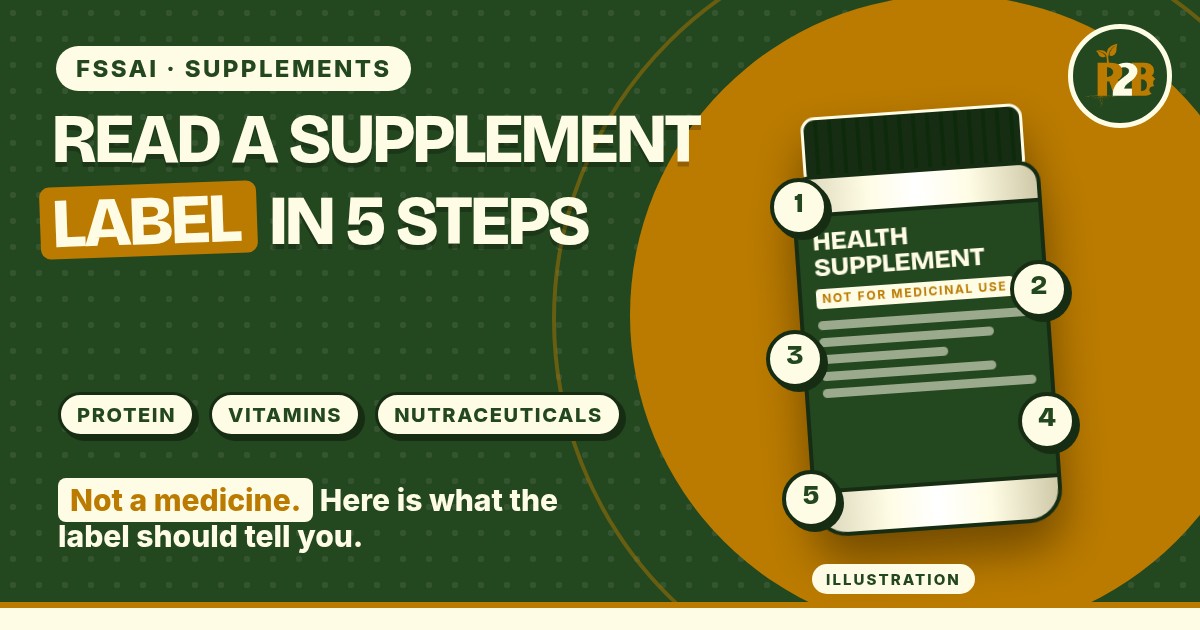
These match the five numbered zones on the graphic at the top.
- 1. Read the category and the “not for medicinal use” line. If a product presents itself as a cure or a treatment, that is a red flag. Supplements are not allowed to claim to prevent or treat disease.
- 2. Find the amount of each active ingredient per serving. A long list of ingredients with no amounts, or a “proprietary blend” that hides the amounts, tells you very little. Check what a serving is and how many servings are in the pack.
- 3. Read the daily use and warnings. Is there a recommended daily amount, and a warning not to exceed it? Taking more of a supplement is not automatically better.
- 4. Read the claims critically. Words like “boosts immunity” or “detox” are marketing. See what food claims really mean. For protein products, see “high protein” on Indian food labels.
- 5. Check the FSSAI number, batch and dates. Verify the number on FoSCoS: see how to check an FSSAI licence number. Then check the dates: see best before, use by and expiry, explained.
Also read the ingredient list
Beyond the active ingredients, the ingredient list shows added sugar, sweeteners, colours and flavours, and the numbers in brackets are additive codes. See what the numbers in an ingredient list mean. Capsules and tablets also contain fillers and coatings; if you follow a vegetarian diet, check whether the capsule shell is plant-based and ask the brand if it is not stated.
Do you need a supplement at all?
For most healthy people, a balanced diet covers the basics. India’s ICMR-NIN guidelines say healthy people can usually meet their protein needs from food and do not need protein supplements. If you are considering a supplement because of a medical condition, pregnancy, age, a restricted diet or heavy training, talk to your doctor or a registered dietitian first, especially if you take regular medication.
What a label cannot tell you
- Whether the amounts printed are what is inside. That needs independent testing. See what a food lab report can and cannot tell you.
- Whether it works for you. A label states ingredients, not results.
- Whether it is safe for your health condition or alongside your medicines. Ask a doctor.
At Root to Bite we try to separate what a brand says, what has been checked, and what is still unknown. A supplement label is the place to start.
Rules and wording change. For the current official requirements, see the FSSAI pages below. This guide is general information, not medical or legal advice. Talk to your doctor or a registered dietitian about supplements.
Frequently asked questions
How do I read a supplement label in India?
Check five things: the category (“health supplement” or “nutraceutical”) and the “not for medicinal use” statement; the amount of each active ingredient per serving; the recommended daily use and warnings; the claims; and the FSSAI number, batch and dates. Verify the FSSAI number on FoSCoS.
Are supplements regulated in India?
Yes, as food. FSSAI’s 2016 regulations cover health supplements, nutraceuticals, foods for special dietary use and related categories. They are not regulated as medicines, and the regulations bar claims to prevent or treat disease.
What does “not for medicinal use” mean on a supplement?
It states that the product is a food supplement, not a medicine, and is not meant to diagnose, treat, cure or prevent any disease. Exact wording can vary.
Is a health supplement the same as a nutraceutical?
They are both covered by FSSAI’s 2016 regulations and sold as food. In everyday use, a health supplement is often a vitamin, mineral, amino acid or protein product, while a nutraceutical is a product with a specific ingredient claimed to support a body function.
How do I check if a supplement has a valid FSSAI licence?
Find the 14-digit FSSAI number on the pack and look it up on FoSCoS (foscos.fssai.gov.in) under FBO Search. Check that the business name and address match the brand.
Do I need protein powder or vitamin supplements?
For most healthy people a balanced diet is enough, and ICMR-NIN’s guidelines say healthy people do not usually need protein supplements. If you have a medical condition, are pregnant, follow a restricted diet or train heavily, ask a doctor or registered dietitian.
Sources
- FSSAI: Compendium of the Health Supplements, Nutraceuticals and related regulations (2021)
- FSSAI: Direction on nutraceutical regulations (30 March 2022)
- S.S. Rana & Co.: Nutraceuticals, labelling compliances under FSSAI
- FSSAI: Food Safety and Standards Authority of India
General information only, not medical or legal advice. The graphic is an illustration. No brand sponsored or reviewed this article.